
I’ve been thinking about Krishna Shenoy, PhD and the kind of legacy that lasts through people.
Professor Krishna Shenoy spent over two decades developing brain-computer interfaces. His work helped create systems that restore communication and movement for people with paralysis. He was both a theorist and an engineer. His lab focused on understanding groups of neurons instead of just individual cells. This approach is now a leading concept in systems neuroscience. He also turned this science into practical technology. In a 2021 Nature paper, a participant with a paralyzed hand typed 90 characters per minute just by imagining handwriting. This more than doubled the previous record for an intracortical BCI. By his death, he had over 38,000 citations and an h-index of 97. (source: wikipedia)
He achieved all this while battling pancreatic cancer for nearly 12 years, diagnosed in 2011.
This fact is worth considering. Krishna co-authored more papers after his diagnosis than before. His colleagues noted how fatigue lifted during deep conversations, as if he thrived on hard problems. Before his first surgery, he wrote recommendation letters for everyone in his lab and updated them when his health declined. When he entered the hospital for the last time, he focused on finishing a letter for a student. He completed it.
I am a scientific grandchild of Krishna. My PI, Vikash Gilja, earned his PhD with Krishna at Stanford and later worked in the Neural Prosthetics Translational Lab (NPTL). This lab, co-led by Krishna Shenoy and Jaimie Henderson, aimed to bring intracortical BCI research to the clinic. Their partnership began in 2005 and later joined the multisite BrainGate clinical trial. Vikash continued this work through academia and industry at UC San Diego, Neuralink, and now Paradromics, where he is Chief Scientific Officer. In November 2025, Paradromics received FDA approval to start its first in-human clinical study — the Connect-One Early Feasibility Study, set for 2026. The link from Krishna’s lab to patients continues.
Krishna trained 21 PhD students and 21 postdocs. His mentees now lead labs at Columbia, the University of Michigan, Emory, UC Davis, Carnegie Mellon, Stanford, and the University of Pittsburgh. They playfully called themselves the “Shenoy Division,” a nod to Joy Division. While I didn’t know Krishna personally, I feel his influence in the field he built, in the people he trained, and in the expectation that this work benefits patients.
You can see this mentorship lineage on Neurotree: https://neurotree.org/beta/tree.php?pid=216
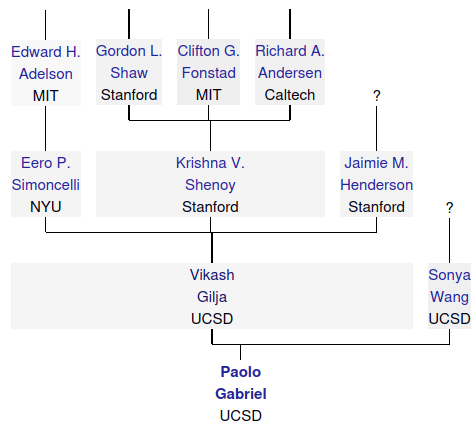
If you haven’t read When Breath Becomes Air by Paul Kalanithi, I recommend it. The neuroscience mentor “V” in the book is Krishna. Paul joined his lab as a graduate student during his neurosurgical residency at Stanford. This parallel stays with me: two people at Stanford, both facing mortality and both trying to understand the brain and help others. Paul died of lung cancer in 2015. Krishna died of pancreatic cancer in January 2023.
I sometimes wonder what kind of scientist I’d be if the lineage I inherited had been different. I don’t have an answer. I just try to make it count.
I only met Krishna once, at an SfN mixer — they had a cocktail named after him. I’m aware that writing about someone you barely knew carries a risk of getting it wrong. If you knew him and I’ve mischaracterized anything, please tell me.