
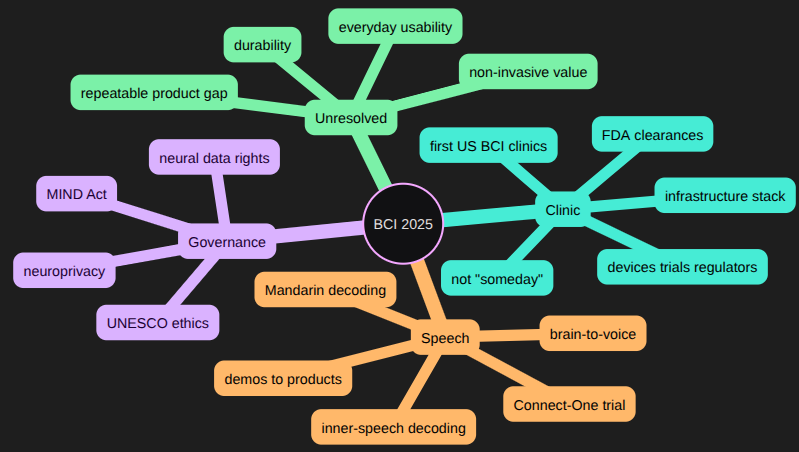
2025 marked a shift for neurotechnology. It felt less like a series of isolated breakthroughs and more like a real field in clinical, commercial, and political arenas.
In this first Neural Noise post, I aim to:
Highlight key developments in 2025.
Set the tone for the kind of writing I’ll share here.
This isn't a detailed annual review; that’s in the research spine underneath. Instead, it’s how I’d explain the year to someone smart, busy, and curious about the future of BCI and neurotech.
In short, 2025 made the field harder to dismiss and summarize.
It became harder to dismiss because more stories were about real devices, patients, approvals, and care pathways. Precision Neuroscience received FDA clearance for a minimally invasive implant. Paradromics hit a first-in-human milestone and later got FDA approval for its Connect-One speech trial. Neuralink continued its implants and expanded trial sites. The University of Michigan Health opened one of the first dedicated BCI clinics in the U.S. The focus shifted from “interesting lab” work to “how does this get used?”
It also became harder to summarize because the field was no longer a single story.
The speech story featured brain-to-voice systems, inner-speech decoding, and tools for those who lost their speech.
The hardware story highlighted denser arrays, wireless systems, and design trade-offs about invasiveness and durability.
The non-invasive story showed finer motor control, serious device efforts, and the need for non-invasive methods.
The governance story included neuroprivacy, neural data protection, UNESCO’s ethics standard, and debates over inferences allowed before full normalization.
If I had to sum up 2025 in three shifts, here’s how:
1. BCI moved closer to the clinic
For years, neurotech was easy to label as "promising, but not yet." In 2025, that changed.
The shift wasn’t a single product; it was the emergence of a complete stack. Devices, trials, regulators, clinics, and patient stories began interacting. FDA clearances for Precision's implant and ONWARD’s ARC-EX, along with Paradromics’ trial approval, made it harder to keep this in the "someday" category. Neuralink’s many implants, Synchron’s Stentrode, and Ceribell’s EEG reinforced that this field is now competing for patients, talent, and capital.
This is what maturity looks like: not certainty, but infrastructure.
2. Speech became the clearest application wedge
If you asked which application best explains the year, I’d say speech and communication.
We saw brain-to-voice neuroprostheses, handwriting decoded from stable neural states, and ECoG work on sentence timing. WVU’s first BCI test for speech, Stanford’s real-time inner-speech decoding, and Neuralink’s planned trial for speech impairment pushed the field from “cool demo” to recognizable product paths. Paradromics’ FDA-approved trial and growing datasets filled the pipeline from invasive to non-invasive, and from English to tonal languages.
Restoring communication is vital. The need is real. When a field can explain its value clearly, it becomes easier to build, regulate, fund, and critique.
3. Governance stopped being a side conversation
One reason I keep returning to neurotechnology is the link between technical progress and governance. If devices can decode speech or infer intention, privacy and consent are essential. They are product, clinical, and legal questions.
In 2025, the ethics conversation became hard to ignore. A neural data bill in Congress, the proposed MIND Act, and UNESCO’s global standard on neurotechnology ethics brought the debate into the open. Secure-pairing work for implants and clinician views on explainability showed these concerns are shaping device and trial design.
A field this ambitious shouldn’t mature in private. 2025 was the first year it felt broadly understood.
What I still want answers on
I don’t think 2025 resolved key issues; it sharpened them. I want clearer answers on durability, usability, and performance in everyday settings. The gap between "excellent demo" and "repeatable product" remains blurred. Non-invasive methods need to prove enduring value, not just novelty. The field is just starting to take neural data rights seriously.
I want to follow the field closely while stepping back to see the larger pattern. In 2025, the pattern became clear: invasive paths to clinics, speech as a wedge, non-invasive systems seeking essential roles, and governance moving to the forefront.
It feels like the right moment to start sharing this journey publicly. Thank you for reading.